AI’s Unsustainable impacts to grow x7 by 2030
Measured against planetary boundaries, the environmental impacts of artificial intelligence are increasing at an unsustainable rate. The Green IT Association is calling for decisive action from public authorities to empower citizens to take action.
The Green IT Association today unveils the results of its study on the environmental and health impacts of artificial intelligence worldwide in 2025 and 2030 (available in French here; English version to be released early December. Key figures follow).
This study is the only Life Cycle Assessment (LCA) to have been carried out on this topic on such a scale. The study focuses on the manufacture of AI servers and their subsequent operation in data centres worldwide for the years 2025 and 2030.
Four major environmental impacts
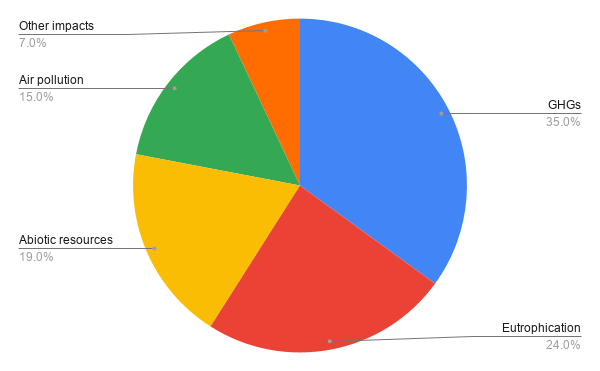
Artificial intelligence contributes primarily to four environmental and health crises:
- Global warming (35%) and its consequences for the climate, populations and ecosystems;
- Eutrophication (24%), or oxygen depletion of aquatic environments
- Abiotic resource depletion (19%): the mineral, metallic and fossil resources required to make AI hardware;
- Fine particulate matter (15%), or air pollution, which already causes 40,000 deaths a year in France (source).
As these figures show, it is very important not to limit the impacts of AI solely to greenhouse gas (GHG) emissions, as this would prevent us from finding systemic solutions – that is, solutions that enable all these impacts to be reduced at the same time.
Sevenfold impacts in 5 years: unsustainable growth
According to the study, in 2025, global AI already accounted for 22% of the European Union’s annual sustainable budget.
But this footprint will increase sevenfold in five years, reaching 143% by 2030 – the equivalent of the sustainable annual budget of 645 million people (1.4 times the EU’s population).
The sustainable annual budget is the amount of environmental and health impacts an individual can have in a year without exceeding planetary boundaries. It is calculated by dividing planetary boundaries by the number of people on Earth.
96% of impacts linked to electricity generation
The manufacture of global AI infrastructure – data centres, servers, storage arrays, cooling systems, etc. – is responsible for over 45 per cent of certain impacts, such as the depletion of abiotic metal and mineral resources. However, it is primarily the generation of the electricity consumed by this infrastructure that accounts for up to 96 per cent of the impacts; impacts linked in particular to the combustion of fossil fuels.
According to our calculations, exponential growth in demand for AI will result in dedicated computing power rising from 24 to 176 gigawatts (GW), which by 2030 will be equivalent to 42 per cent of current global nuclear generation capacity.
The study also reveals that GPUs dedicated to AI will consume seven times more electricity between 2025 and 2030 (it should be noted that the Association’s 2025 report had projected a fourfold increase in this figure, illustrating the speed at which the associated impacts are growing).
The reason for this is the predicted doubling of the number of GPUs in operation worldwide (from 13 to 25 million between 2025 and 2030); according to the study, the average power consumption of these GPUs is set to triple, rising from 700 to 2,000 watts.
The total floorspace of data centres will have to increase considerably – sixfold – in order to accommodate all the new AI servers expected to come online worldwide, the study states. This finding is all the more alarming as it suggests that the current doubling of data centre capacity underway in the United States (source) may prove insufficient.
5 Recommendations for more frugal AI
Faced with such impacts, one question in particular springs to mind: do we really need this much IT capacity, and for what purpose in society?
We therefore believe it is essential to prioritise in-depth studies to chart a viable path for AI deployment; our work actively contributes to this objective.
The Green IT Association as such proposes five approaches to help mitigate these impacts:
- Enact legislation in favour of an ‘AI sobriety’ plan, to contain expansion
- Empower citizens to take action (for example, via labelling of AI systems, as with food).
- Formalise French excellence in frugal and responsible AI
- Make eco-design mandatory for AI systems hosted in France
- Introduce a tax on AI centres powered by fossil fuels (bonus-malus system)/
Beyond the actions that every citizen can take in their daily lives – using AI only when necessary, opting for modes and models that consume less resources, etc. – public authorities have a crucial role to play. And yet no regulatory framework for this technology is planned at either the French or European level. There is no relevant legislation in France, and the European AI Act does not address environmental considerations in its current form.
A rigorous scientific methodology
The standard methods used in this study are multi-criteria Life Cycle Assessment (LCA) (ISO 14040/44), the European Commission’s Product Environmental Footprint (PEF), and ADEME’s ‘digital services’ Product Category Profile (PCP). The calculations are based primarily on the NegaOctet.eu and EcoInvent databases.
All stages of the life cycle – manufacturing, distribution, use and end-of-life – were taken into account for 16 standard impact indicators. The results were normalised and weighted to produce a single environmental score (EcoScore PEF).
